
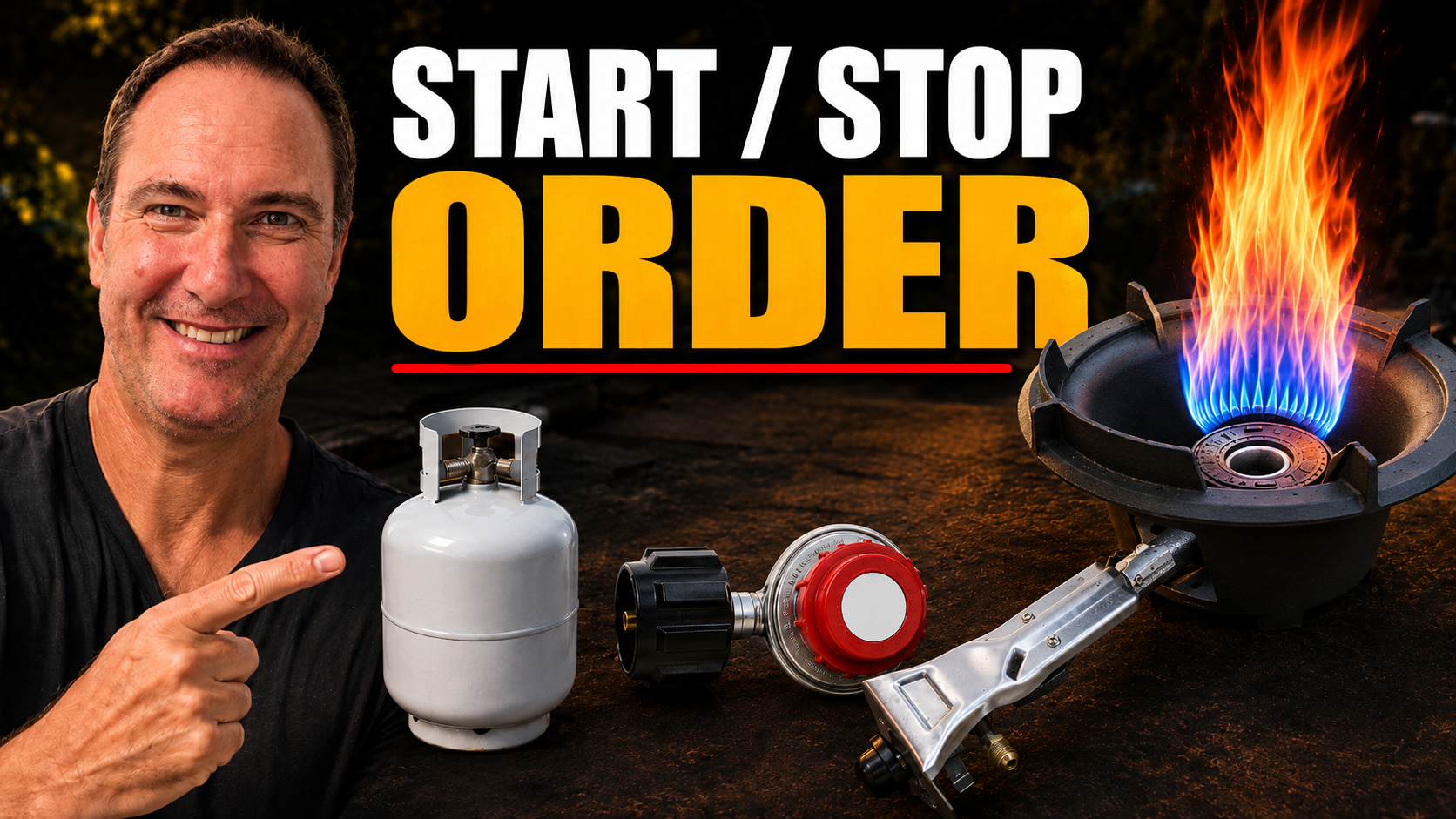
Starting a high-pressure wok burner is easy once you know the sequence. The first few times, though, you have three different controls in front of you, and it is not immediately obvious which one should come first.
There is the propane tank, the adjustable high-pressure regulator, and the burner control.
The easiest way I have found to remember it is:
START: TANK → REGULATOR → BURNER
When I shut the burner down, I use a different sequence:
SHUTDOWN: TANK OFF → FLAME BURNS OUT → BURNER OFF → REGULATOR OFF
The ignition itself only takes a few seconds. What matters is having a routine and following it the same way each time.
This guide shows the process on the high-pressure propane wok burner setup in the video below.
Important: This procedure applies to the type of high-pressure propane wok burner shown here, with an adjustable regulator and burner control. Follow the instructions supplied with your own burner and regulator if they specify a different procedure.
Before You Light the Wok Burner
I start with everything off.
The propane cylinder valve is closed. The adjustable regulator is in its closed position. The burner control is off.
The burner should also already be connected correctly and leak-tested.
That last part matters. Lighting the burner is not the time to find out that a gas connection is leaking.
If you have just assembled the burner, changed a regulator, disconnected a gas fitting, or reconnected part of the gas system, perform a proper leak test before ignition.
Once the system is connected, checked, and all three controls are off, I start at the tank.
Step 1: Open the Propane Tank
Slowly open the propane cylinder valve according to the instructions for your propane setup.
On the setup shown in the video, I then open the cylinder valve fully.
The important point is that I am not using the tank valve to control cooking heat.
The cylinder valve controls the propane supply. If I want to change the flame while cooking, I use the burner control and, when needed, the adjustable regulator.
Step 2: Introduce Pressure With the Regulator
With the propane supply open, I move to the adjustable high-pressure regulator.
I start low.
There is no reason to open the regulator fully before ignition. I only need enough pressure for the burner to light cleanly.
Once the burner has ignited and the flame is stable, I can increase the available pressure if I need more heat.
This is why the startup order makes sense:
The tank supplies the gas.
The regulator introduces pressure.
The burner comes last.
So remember:
TANK → REGULATOR → BURNER
Step 3: Press and Turn the Ignition Knob
Now I ignite the burner.
The burner shown in the video uses a push-and-turn ignition control. I press the knob inward and turn it to ignite.
Pressing the knob allows a small amount of gas to flow through the pilot line. Turning the control activates the ignition and produces the spark that lights the incoming gas.
You should hear the ignition click and see the burner light.
Once the flame is stable, I can start adjusting the burner.
And this is worth mentioning: high-pressure wok cooking does not mean running the burner at maximum power all the time.
Sometimes I want very strong heat, for example when preheating the wok or recovering heat after adding ingredients.
At other times I pull the flame back immediately.
Having that range is what makes a powerful wok burner useful.
The Startup Sequence in Practice
Once you have done it several times, the whole procedure is very short:
- Open the propane tank.
- Introduce a small amount of pressure with the regulator.
- Press and turn the burner control to ignite.
- Check that the flame is stable.
- Adjust the burner as needed.
For normal startup, that is really all there is to it.
The situation that deserves more attention is when the burner does not light.
What If the Wok Burner Does Not Ignite?
If the burner does not ignite within about five seconds, I stop.
I do not keep gas flowing while repeatedly clicking the igniter and hoping it eventually catches.
I:
- Turn the burner control back to OFF.
- Close the regulator.
- Close the propane cylinder valve.
Then I wait at least five minutes before trying again.
This gives any unburned propane time to disperse.
If I try again, I start from the beginning:
TANK → REGULATOR → BURNER
If the burner repeatedly refuses to ignite, or if I smell propane, I stop trying to light it.
At that point, I need to find the cause.
It could be the gas supply, regulator, ignition system, connection, or another part of the setup.
Never use an open flame to search for a gas leak. For more info check our guide on how to check for gas leaks on wok burner.
How to Shut Down a High-Pressure Wok Burner
Shutdown is where the order becomes a little less obvious.
You might assume you simply reverse the startup sequence.
That is not how I shut down the setup shown in this guide.
I close the propane supply at the cylinder first while the burner is still running.
Then I let the burner consume the propane that remains downstream of the cylinder.
The sequence is:
TANK OFF → FLAME BURNS OUT → BURNER OFF → REGULATOR OFF
Step 1: Close the Propane Tank
With the burner still operating, I fully close the propane cylinder valve.
The flame does not necessarily disappear immediately.
That is expected.
There is still propane downstream of the cylinder inside the pressurized part of the system.
I leave the burner operating.
Step 2: Let the Flame Go Out
Now I simply watch the flame.
It may continue burning briefly after the cylinder has been closed. As the remaining gas is consumed, the flame gets weaker and eventually goes out.
I wait until it is completely gone.
This means the remaining downstream propane has been burned through the burner rather than deliberately released unburned.
There is no need to rush this part.
Step 3: Turn the Burner Control Off
Once the flame is completely out, I turn the burner control to OFF.
This is an easy step to forget because visually the burner already looks shut down.
I still return the control to its proper OFF position.
Step 4: Close the Regulator
Finally, I return the adjustable high-pressure regulator to its closed position.
Now I check the whole setup:
- Propane tank: CLOSED
- Burner control: OFF
- Regulator: CLOSED
- Flame: OUT
That is how I want to leave the burner after cooking.
Why I Use the Same Routine Every Time
The main reason I use a fixed routine is not because starting a wok burner is complicated.
It is because it removes decisions.
I do not want to stand in front of the burner wondering which valve I opened first last time or whether I left the regulator turned up.
I start from a known condition:
Everything off.
Then:
TANK → REGULATOR → BURNER
When I finish cooking:
TANK OFF → FLAME BURNS OUT → BURNER OFF → REGULATOR OFF
After you use the burner regularly, you barely need to think about the sequence anymore.
But you still follow it.
Common Wok Burner Startup Mistakes
Opening the Regulator Fully Before Ignition
You do not need maximum pressure to light the burner.
Start with enough pressure for a clean ignition, then increase it once the flame is stable.
Using the Propane Tank Valve to Adjust Heat
The cylinder valve controls the propane supply.
Use the burner control and appropriate regulator adjustment when you need to change the cooking heat.
Repeatedly Clicking After a Failed Ignition
If the burner has not lit within about five seconds, stop.
Close the gas supply and wait at least five minutes before starting the procedure again.
Trying Again When You Smell Propane
Do not treat the smell of propane as a simple ignition problem.
Keep the burner off and check the gas system before attempting another ignition.
Forgetting the Controls After the Flame Goes Out
During the shutdown procedure shown here, the burner control and regulator still need to be returned to their OFF positions after the flame has burned out.
The Two Sequences Worth Remembering
If you return to this guide months from now because you cannot remember the order, this is the part you need.
Starting
TANK → REGULATOR → BURNER
Open the propane supply, introduce pressure with the regulator, then ignite the burner.
Shutting Down
TANK OFF → FLAME BURNS OUT → BURNER OFF → REGULATOR OFF
Close the propane supply, allow the remaining downstream gas to burn, switch the burner off, then close the regulator.
That is the routine I use on the high-pressure wok burner setup shown in the video.
Before first ignition, and whenever relevant parts of the gas system have been disconnected and reconnected, make sure the setup has been properly leak-tested.
If you are setting up your wok burner for the first time, continue with our wok burner leak-test guide and high-pressure regulator setup guide.
If you are looking for a dedicated outdoor burner built for serious high-heat wok cooking, take a look at the Blastrz Blaze Wok Burner.
Leave a Reply
You must be logged in to post a comment.